


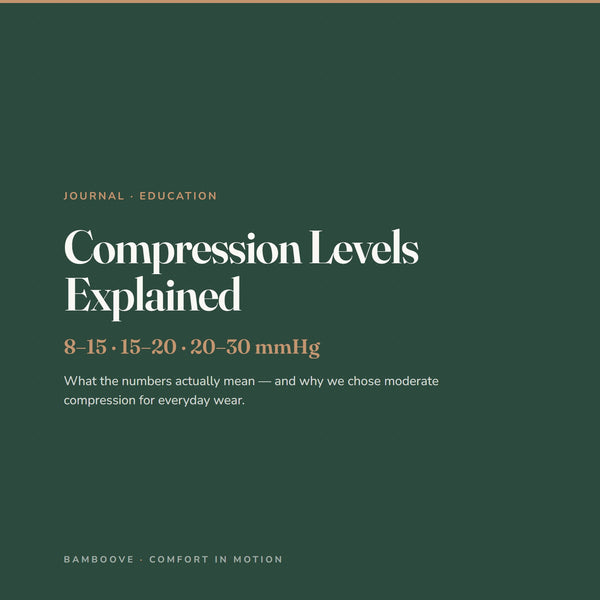

You see the numbers on the packaging: 8 to 15 mmHg, 15-20 mmHg, and 20 to 30 mmHg. You wonder what any of this actually means. It feels like a code you need to crack before you can buy a pair of socks.
Here is the thing: it is not as complicated as it looks.
mmHg stands for millimetres of mercury. It is the standard unit for measuring compression pressure. Think of it like this: if you pressed your thumb gently against your forearm, that might be around 5 to 10 mmHg. Press harder, and the number goes up.
What matters is not just how firm the compression is, but how it is distributed. The key principle is called graduated compression: the pressure is strongest at your ankle and gradually decreases as it moves up toward your calf. This helps push blood back toward your heart, which is exactly what compression socks are designed to do.
The three levels you will see
8 to 15 mmHg is light compression. It is barely noticeable when you put it on, but it provides a gentle boost to your circulation. This is ideal if you sit at a desk all day, drive long distances, or are new to compression and not sure if you will like it.
15-20 mmHg is moderate compression. This is the sweet spot for everyday wear. It is firm enough to make a real difference if you are on your feet all day, even for nurses, teachers, and retail workers, but gentle enough to wear comfortably for twelve hours without feeling like your legs are being squeezed. Most people who benefit from compression socks find this level works best for their daily lives.
20 to 30 mmHg is firm compression. This is the medical-grade level. It is significantly tighter and should generally be used under medical supervision, after surgery, for severe swelling, or for specific circulatory conditions. It is not designed for everyday casual wear.
Why we chose 15-20 mmHg
At Bamboove, we focus on everyday comfort, not medical treatment. That is why all our knee-high socks use 15-20 mmHg moderate compression. Here is why we chose that level.
It is firm enough to actually help. If you are standing for eight hours, you will feel the difference. But it is also gentle enough to wear all day without discomfort. You do not need to take them off after a few hours because they feel too tight.
It works for almost everything. Whether you are at work, walking around, travelling, or just relaxing at home, 15-20 mmHg adapts. You do not need different socks for different situations.
You do not need a prescription. Unlike firm compression, moderate compression is available off the shelf. You can buy it, wear it, and benefit from it without a doctor's note.
How to choose your level
Ask yourself three simple questions.
First, how long are you on your feet? Less than four hours a day, and light compression might be enough. More than six hours, and moderate is better.
Second, what do you do? Mostly sitting means light. Standing or walking all day means moderate. A medical condition means talk to your doctor first.
Third, how do your legs feel? Mild fatigue that goes away overnight is one thing. Regular heaviness or visible swelling is another. If it is the latter, moderate compression is more likely to help.
A few things people get wrong
Higher is not always better. Firm compression is designed for specific medical situations. For everyday comfort and prevention, moderate is usually the right choice.
Compression is not just for older people. Anyone who spends long periods standing or sitting can benefit. Young nurses, office workers, and frequent flyers all find value in it.
They are not that hard to put on. Yes, they require a bit more effort than regular socks. But the trick is simple: roll the sock down to the heel, slip your foot in, then unroll gently up your leg. After a couple of wears, it becomes second nature.
Where our socks sit
Our Comfort Crew offers 8 to 15 mmHg light compression. It is perfect if you are new to compression, if you sit most of the day, or if you want something for travel and casual wear.
Our Classic Knee-High and Essential Knee-High both offer 15-20 mmHg moderate compression. This is our everyday workhorse, the sock we recommend for nurses, teachers, retail workers, and anyone who spends long hours on their feet.
If you are still not sure, our Size Guide has measurement instructions for every style.
This guide is for informational purposes only. If you have circulatory conditions or medical concerns, please consult a healthcare professional before purchasing compression socks.